The German Genitive Case: How to Say Whose Something Is
The genitive case (der Genitiv) is how German says that something belongs to someone or is part of something. You use it in phrases such as das Fahrrad meiner Schwester (my sister's bike), die Adresse des Restaurants (the address of the restaurant), and am Ende des Monats (at the end of the month).
English marks the owner with "'s" or "of". German puts the owner after the thing and changes the owner's article, so meine Schwester (my sister) becomes meiner Schwester. This post covers the articles, the noun endings, names, and when German uses von (of) instead.
Try it first
Pick the form that fits the gap. Read the short reason after each answer.
The rules below explain why each form works.
Every rule in this guide as a question-and-answer card. Flip to reveal the answer, rate how well you knew it, and drill until it sticks.
Practice the deckWhat the genitive does
- The genitive shows who or what something belongs to.
- When it shows possession, there are always two nouns: the thing and its owner.
- Only the owner is in the genitive.
- The genitive answers the question Wessen? (whose?).
A genitive phrase for possession always has two nouns. The first noun is the thing, and the second noun is the owner. Only the owner is in the genitive.
In das Fahrrad meiner Schwester (my sister's bike), das Fahrrad is the thing and meiner Schwester is the owner. The owner can also be a whole that the thing is part of. In das Ende der Straße (the end of the street), the street is the owner of its end.
Two more examples:
- der Geburtstag meiner Mutter (my mother's birthday)
- der Preis des Tickets (the price of the ticket)
English has two ways to show this idea. You can use "'s", as in "my mother's birthday", or "of", as in "the price of the ticket". German uses the genitive for both.
The question word is Wessen? (whose?).
Wessen Fahrrad ist das? (Whose bike is that?) Das ist das Fahrrad meiner Schwester. (That is my sister's bike.)
Wessen Schlüssel sind das? (Whose keys are these?) Das sind die Schlüssel meines Mitbewohners. (These are my flatmate's keys.)
If you want to learn about all four German cases, read our guide to the German cases.
Where the genitive goes in the sentence
- The thing comes first and the owner comes after it.
- Only the owner is in the genitive.
- The thing is in the case that its role in the sentence needs, like any other noun.
German normally puts the thing first and the owner after it: das Fahrrad meiner Schwester (my sister's bike). Word for word, this is "the bike of my sister".
English puts the owner first in "my sister's bike". German normally does this only with names, as you will see below.
The thing is a normal noun. It can be the subject, the direct object, or come after a preposition, and its article shows that case as usual. The owner is in the genitive in every one of these sentences:
| Role of the thing | Sentence |
|---|---|
| Subject (Nominativ) | Der Bruder meiner Freundin wohnt in Berlin. (My friend's brother lives in Berlin.) |
| Direct object (Akkusativ) | Ich kenne den Bruder meiner Freundin. (I know my friend's brother.) |
| After mit (Dativ) | Ich spiele Tennis mit dem Bruder meiner Freundin. (I play tennis with my friend's brother.) |
The thing changes from der Bruder to den Bruder to dem Bruder. The owner is meiner Freundin in all three sentences.
The owner changes only once, when it goes into the genitive: meine Freundin (my friend) becomes meiner Freundin, and mein Onkel (my uncle) becomes meines Onkels. After that it looks the same wherever the phrase stands in the sentence.
The genitive articles
- There are only two endings to learn: -es and -er.
- Masculine and neuter use -es: des, eines, meines.
- Feminine and plural use -er: der, einer, meiner.
- The plural has no form of ein.
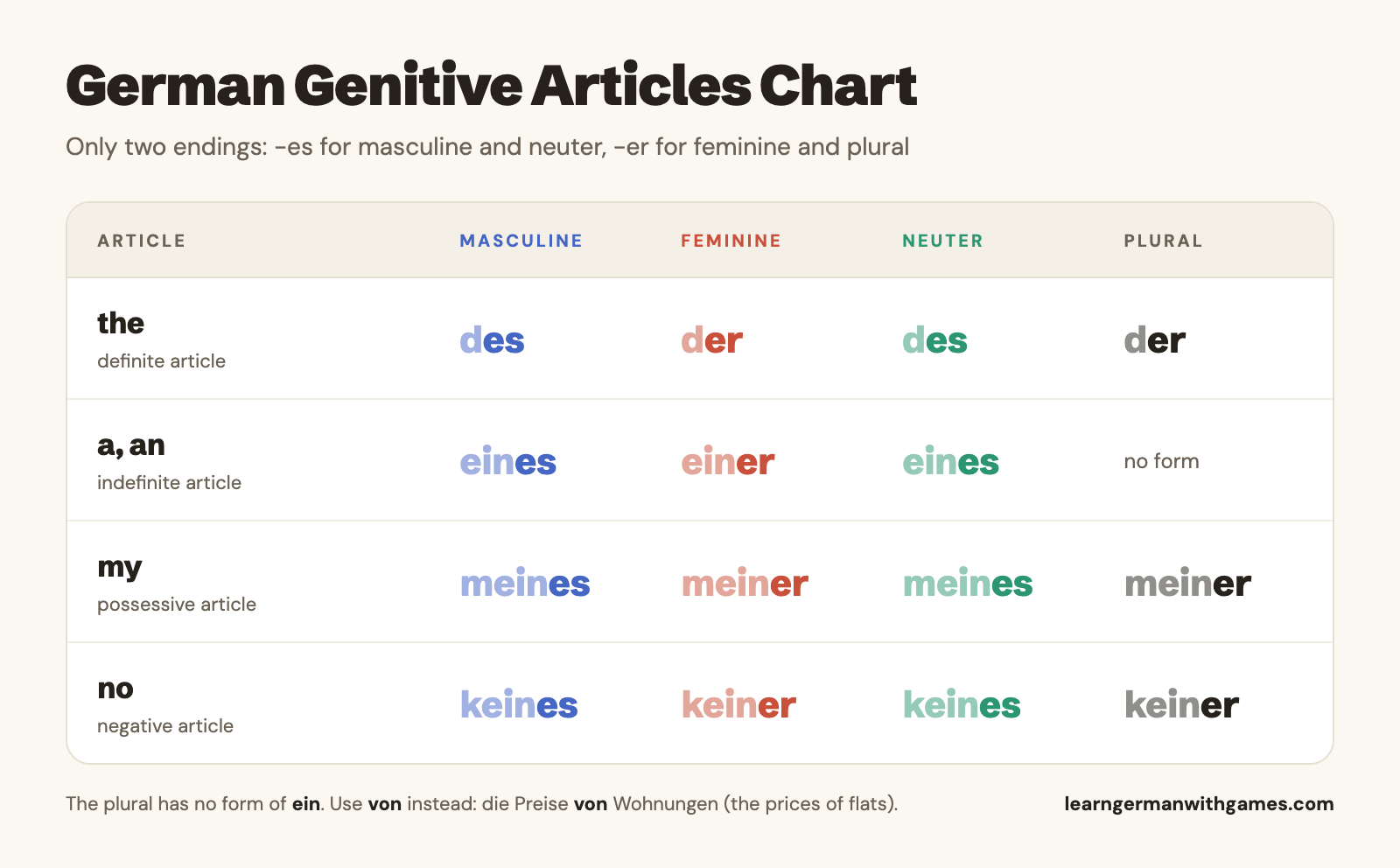
This is the most useful fact in the post: every genitive article ends in -es or -er.
| Masculine | Feminine | Neuter | Plural | |
|---|---|---|---|---|
| the | des | der | des | der |
| a | eines | einer | eines | (no form) |
| my | meines | meiner | meines | meiner |
| no | keines | keiner | keines | keiner |
The chart is also an image that you can save or print:
Here is the genitive in full sentences:
- Der Akku des Handys ist leer. (The phone's battery is empty.)
- Die Tochter der Nachbarin geht in meine Klasse. (The neighbour's daughter is in my class.)
- Die Zimmer der Kinder sind oben. (The children's rooms are upstairs.)
- Heute ist der Geburtstag einer Freundin. (Today is a friend's birthday.)
- Sie ist die Chefin eines Restaurants. (She is the boss of a restaurant.)
- Die Wohnung meines Onkels ist sehr klein. (My uncle's flat is very small.)
Other possessive words follow the same pattern as mein. For example, you can say deines Onkels (of your uncle) and unserer Stadt (of our town).
The forms keines and keiner are rare. At this stage, you only need to recognise them when you see them.
Here are two examples with ein: der Geburtstag einer Freundin (a friend's birthday) and der Besitzer eines Cafés (the owner of a café).
You need the gender of the noun before you can choose the article. If you need to review noun genders, read our der, die, das post.
The noun gets an ending too
- Masculine and neuter nouns add -s or -es.
- Longer nouns usually add -s.
- Short nouns with one syllable usually add -es.
- Nouns ending in -s, -ß, -x, or -z always add -es.
- Feminine and plural nouns add no ending.
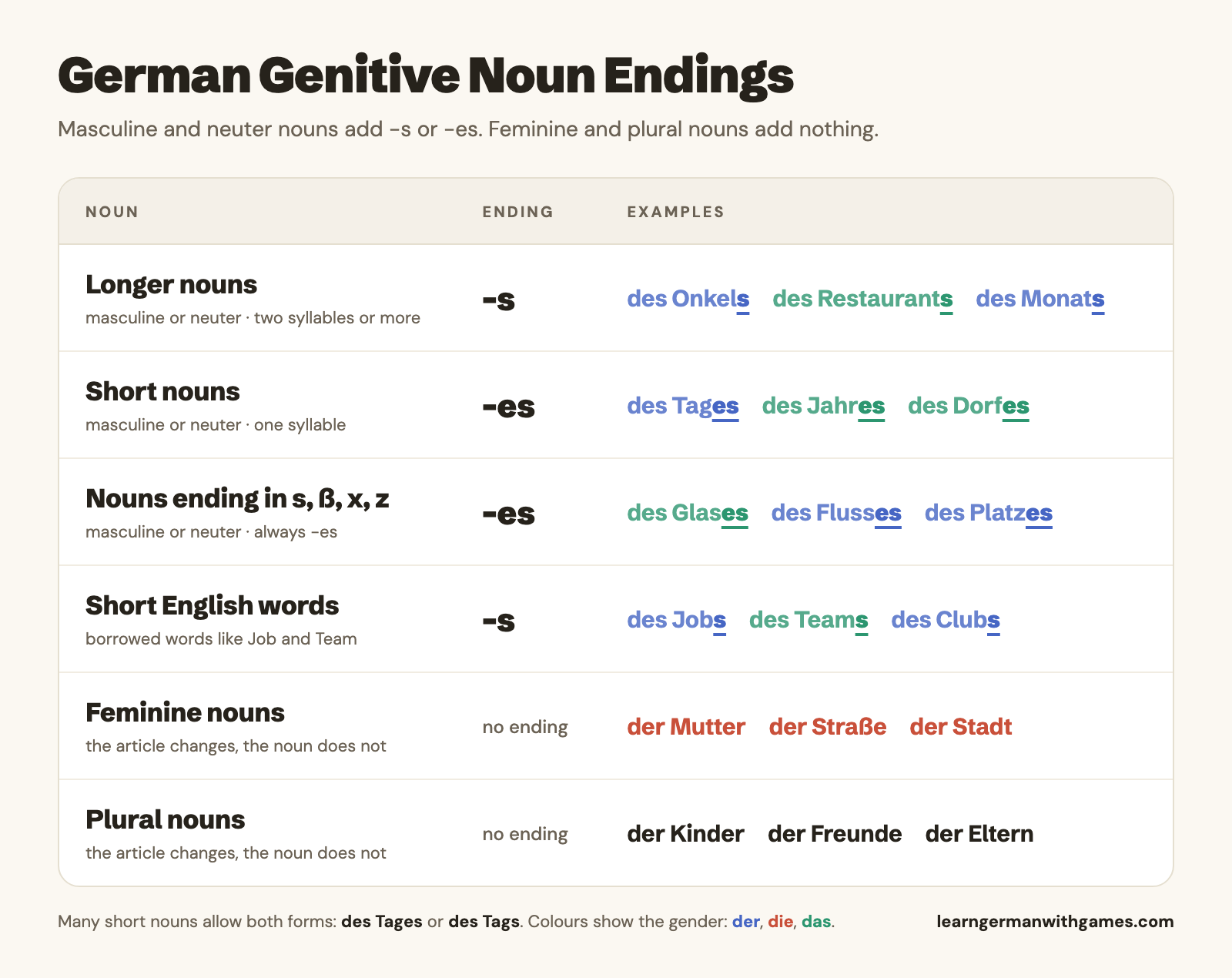
The article isn't the only change. Masculine and neuter nouns also add -s or -es in the genitive.
Longer nouns, with more than one syllable, usually add -s:
| Noun | Genitive | Example |
|---|---|---|
| der Onkel (uncle) | des Onkels | die Wohnung meines Onkels (my uncle's flat) |
| das Restaurant (restaurant) | des Restaurants | die Adresse des Restaurants (the address of the restaurant) |
| der Monat (month) | des Monats | am Ende des Monats (at the end of the month) |
| das Ticket (ticket) | des Tickets | der Preis des Tickets (the price of the ticket) |
Short nouns with one syllable usually add -es:
| Noun | Genitive | Example |
|---|---|---|
| der Tag (day) | des Tages | am Ende des Tages (at the end of the day) |
| das Jahr (year) | des Jahres | am Anfang des Jahres (at the start of the year) |
| das Dorf (village) | des Dorfes | die Kirche des Dorfes (the church of the village) |
| das Buch (book) | des Buches | der Anfang des Buches (the start of the book) |
This is a useful habit, but it is not a strict rule. Many short nouns allow both forms, such as des Tages and des Tags. A dictionary shows the genitive form for every noun.
Short words borrowed from English usually add only -s: des Jobs (of the job), des Teams (of the team), and des Clubs (of the club).
Nouns ending in an s sound always add -es. An ending with only -s would be difficult to say.
| Noun | Genitive | Example |
|---|---|---|
| das Glas (glass) | des Glases | der Rand des Glases (the rim of the glass) |
| der Fluss (river) | des Flusses | am Ufer des Flusses (on the bank of the river) |
| der Platz (square) | des Platzes | in der Mitte des Platzes (in the middle of the square) |
Feminine nouns don't get an ending: der Geburtstag meiner Mutter (my mother's birthday) and das Ende der Straße (the end of the street).
Plural nouns don't get an ending either: die Fahrräder der Kinder (the children's bikes) and die Eltern meiner Freunde (my friends' parents).
See these endings in full sentences:
- Am Ende des Monats habe ich wenig Geld. (At the end of the month I have little money.)
- Der Preis des Tickets ist zu hoch. (The price of the ticket is too high.)
- Am Ende des Tages bin ich müde. (At the end of the day I am tired.)
- Das Café ist in der Mitte des Platzes. (The café is in the middle of the square.)
- Der Geburtstag meiner Mutter ist im Mai. (My mother's birthday is in May.)
- Die Fahrräder der Kinder stehen im Keller. (The children's bikes are in the cellar.)
Here are the noun endings in one image:
Names: Julias Wohnung
- A name adds -s and comes before the thing.
- German writes no apostrophe before this -s.
- A name ending in -s, -ß, -x, or -z gets an apostrophe and no extra -s.
Names work differently from other owners. A name comes before the thing and adds -s: Julias Wohnung (Julia's flat) and Toms Schwester (Tom's sister).
German writes no apostrophe before this -s. English writes "Julia's", while German writes Julias.
A name that already ends in an s sound gets an apostrophe but no extra -s: Lukas' Zimmer (Lukas's room) and Max' Fahrrad (Max's bike).
In speech, von (of) plus a name is very common: die Wohnung von Julia (Julia's flat) and das Zimmer von Lukas (Lukas's room).
These sentences show both forms:
- Julias Wohnung ist im dritten Stock. (Julia's flat is on the third floor.)
- Toms Schwester arbeitet in Wien. (Tom's sister works in Vienna.)
- Lukas' Zimmer ist klein. (Lukas's room is small.)
- Die Wohnung von Julia ist im dritten Stock. (Julia's flat is on the third floor.)
When German uses von instead
- A plural noun with no article uses von plus Dativ.
- In speech, von plus Dativ often replaces the genitive.
- Both forms are correct, and the genitive is more common in writing.
The plural has no form of ein. This means that a plural noun with no article cannot show the genitive in the usual way.
With an article, you can say die Preise der Wohnungen (the prices of the flats). With no article, use von plus Dativ: die Preise von Wohnungen (the prices of flats). Another example is der Lärm von Autos (the noise of cars).
In everyday speech, people also often use von plus Dativ where writing uses the genitive. Both forms are correct:
- das Fahrrad meiner Schwester = das Fahrrad von meiner Schwester (my sister's bike)
- die Wohnung meines Onkels = die Wohnung von meinem Onkel (my uncle's flat)
- das Auto meiner Eltern = das Auto von meinen Eltern (my parents' car)
Here are examples in full sentences:
- Die Preise von Wohnungen sind in Berlin hoch. (The prices of flats are high in Berlin.)
- Der Lärm von Autos stört mich. (The noise of cars bothers me.)
- Das ist das Fahrrad von meiner Schwester. (That is my sister's bike.)
The genitive is more common in writing, including news, signs, forms, and emails at work. You may see it more often than you need to say it at this level, and that's normal.
If you want to review the Dativ forms after von, see our dative prepositions post.
Adjectives in the genitive
- After a genitive article, the adjective always ends in -en.
- This is the same for masculine, feminine, neuter, and plural.
After a genitive article such as des, der, eines, einer, meines, or meiner, the adjective ending is always -en.
| Example | English | |
|---|---|---|
| Masculine | am Ende eines langen Tages | at the end of a long day |
| Feminine | die Küche der neuen Wohnung | the kitchen of the new flat |
| Neuter | der Besitzer des kleinen Cafés | the owner of the small café |
| Plural | die Fahrräder der kleinen Kinder | the little children's bikes |
The same ending in full sentences:
- Am Ende eines langen Tages trinke ich gern Tee. (At the end of a long day I like to drink tea.)
- Die Küche der neuen Wohnung hat ein Fenster. (The kitchen of the new flat has a window.)
- Der Besitzer des kleinen Cafés kennt alle Gäste. (The owner of the small café knows all the guests.)
- Die Eltern meiner besten Freundin kommen aus Spanien. (My best friend's parents come from Spain.)
For adjective endings in the other three cases, use our adjective endings post.
Mistakes learners make
| Wrong | Right | Why |
|---|---|---|
| das Fahrrad meine Schwester | das Fahrrad meiner Schwester | A feminine owner needs the ending -er. |
| die Wohnung meines Onkel | die Wohnung meines Onkels | A masculine noun adds -s in the genitive. |
| der Geburtstag meiner Mutters | der Geburtstag meiner Mutter | Feminine nouns add no ending. |
| meiner Schwester Fahrrad | das Fahrrad meiner Schwester | The owner comes after the thing. Only names come first. |
| Julia's Wohnung | Julias Wohnung | German writes no apostrophe before the -s. |
| die Küche der neue Wohnung | die Küche der neuen Wohnung | After a genitive article the adjective ends in -en. |
| die Preise Wohnungen | die Preise von Wohnungen | A plural noun with no article needs von. |
Practise the genitive
Look around your home and write five phrases about things that belong to someone. Write two with a feminine owner, two with a masculine or neuter owner, and one with a name. You can use ideas such as a sister's bike or a flatmate's keys.
Check the article ending, -es or -er, and check whether the noun needs -s or -es. Every genitive form starts with the gender of the noun, so use Artikel Drop to practise der, die, and das.